
Insights from ACECQA's Q2 2026 Data
Key Messages
Exceeding practice rarely happens without strong staffing. Only 1% of services working towards QA4 exceed in educational program (QA1). None exceed in relationships with children (QA5). No service exceeding QA4 is working towards either area. When staffing falls short, educators appear to protect their relationships with children first. Among services working towards QA4, 65% are also working towards QA1, but only 37% are working towards QA5.
Quality in early childhood education and care programs rests fundamentally on the daily interactions between educators and children. The National Quality Framework recognises this by making Staffing Arrangements one of its seven quality areas, covering qualifications, ratios and the continuity of relationships between educators and children. Where a service is short-staffed or carrying constant turnover, children lose the relational consistency they need, and educators lose the conditions to do their work well.
This analysis of the ACECQA quarter 2, 2026 data looks at how the sector is tracking against QA 4, together with the other quality areas that impact relational pedagogy and practice: QA 5 Relationships with children, and QA 7 Governance and leadership.
What is the strength of staffing arrangements (QA4) across the sector?
The aim of Quality Area 4 under the National Quality Standard is to ensure the provision of qualified and experienced educators, coordinators and nominated supervisors who can develop warm, respectful relationships with children, create safe and predictable environments and encourage children’s active engagement in the learning program.
This quality area is further broken down into two core concepts – how educators are organised (i.e., rosters, continuity of staff), and professionalism (how professional standards guide practice, leadership builds a collaborative workplace).
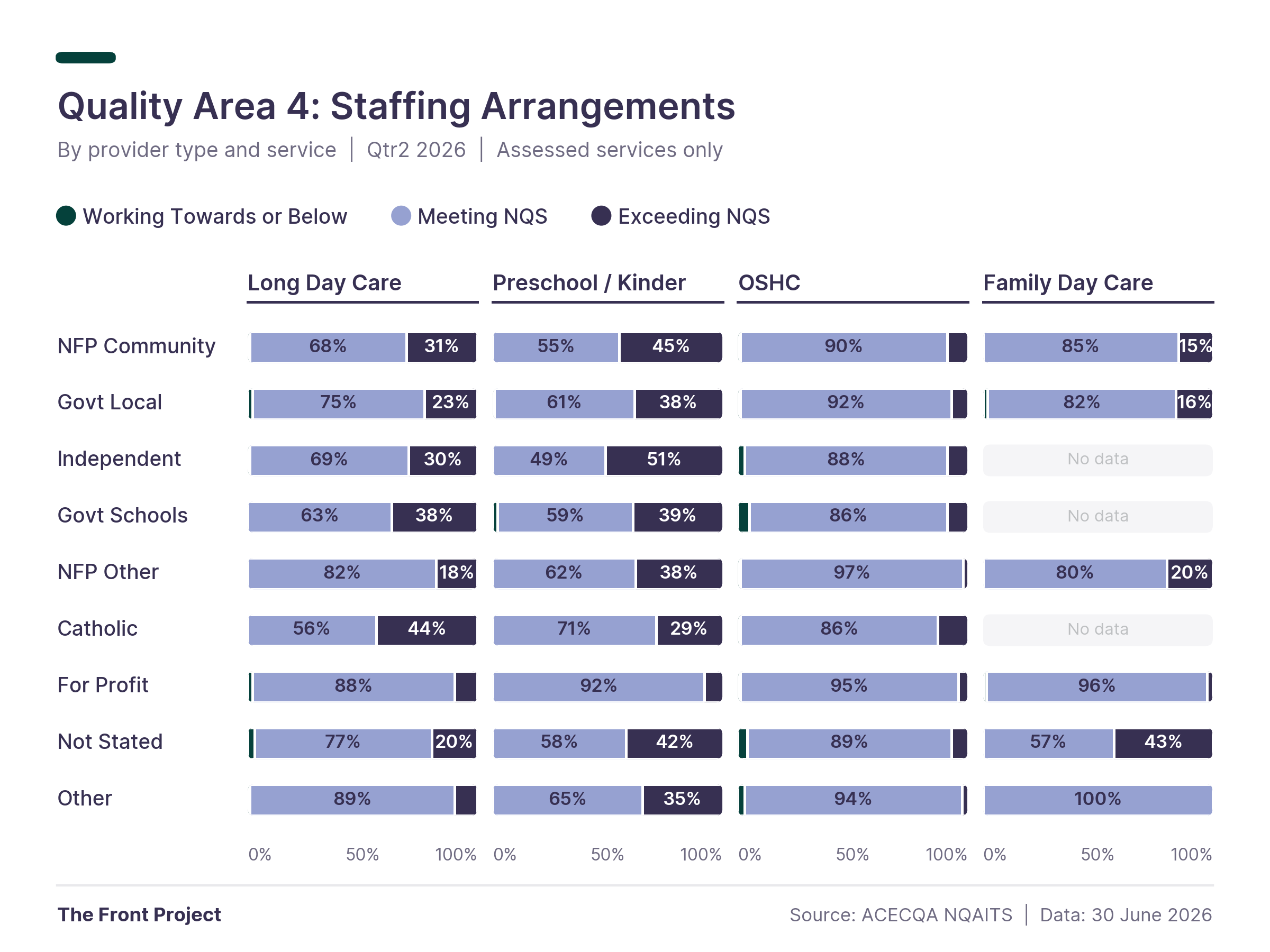
Across assessed services in quarter 2, provider type shows a strong pattern when it comes to Quality Area 4. For-profit providers are concentrated at Meeting on Staffing Arrangements, consistently across long day care, preschool and kindergarten, outside school hours care and family day care. Not-for-profit and government providers show a wider spread, with a larger share rated Exceeding, though the proportion varies by setting and by provider.
Looking at service type, staffing arrangements are stronger in preschool/kinder compared to long daycare. This could in part be reflected by the difference in qualification requirements in PSK compared to LDC, with PSK requiring a teacher in the room whereas LDC requires a certain number of teachers for the centre overall based on service size, but the rostering of those teachers to rooms will vary with the teacher typically allocated to the PSK rooms.
It may also reflect that preschool and kindergarten services receive stronger government subsidy, including free or heavily subsidised provision in some states, which reduces reliance on parent fees and supports stronger staffing conditions.
How closely is QA4 linked to overall NQS ratings?
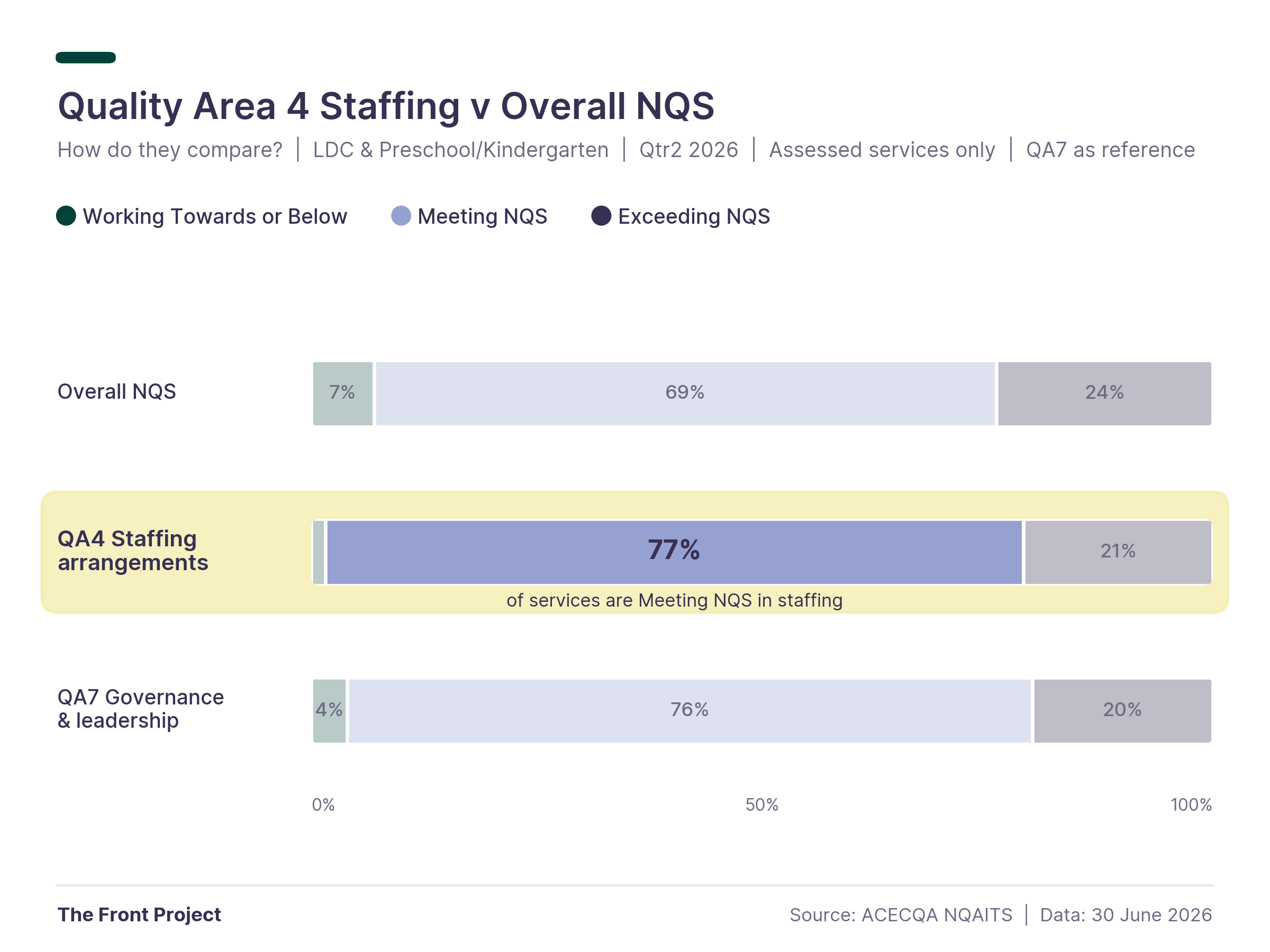
Fewer services are rated Working Towards in QA4 than overall (around 2% compared with 7%), but fewer are also rated Exceeding (21% compared with 24%). Both gaps are partly built into how ratings work. A Working Towards rating in any single quality area produces a Working Towards rating overall, so the overall figure captures every service falling short anywhere. At the other end, services can achieve Exceeding overall without Exceeding in QA4.
It’s also worth noting that the system measures what it can count. QA4 and QA7 are the most structural areas in the standard. Ratios, qualifications and management systems are things a service puts in place and maintains, and they are verifiable against a roster, a file or a policy document. Judging educational program or relationships with children is harder, for the assessor and for the service.
Is there a relationship between staffing (QA4) and leadership (QA7)?
Quality Area 7 of the National Quality Standard (NQS) is Governance and Leadership. It focuses on how an education and care service is managed and led to ensure high-quality, consistent care. It covers:
Governance: having clear, effective systems and processes for managing the service, including well-defined roles and responsibilities.
Leadership: building a positive organisational culture and professional learning community, with strong leadership that promotes continuous improvement.
Management systems: ensuring policies, procedures, and records support compliance with regulations and quality practice.
Educator wellbeing and professional development: supporting staff to develop skills, reflect on practice, and work collaboratively.
These are the structures that enable a service to deliver quality outcomes consistently across every other quality area. What QA4 determines is whether anyone has the time to build them.
Staffing compliance is a floor. Meeting QA4 means holding the regulated minimum. Exceeding means staffing beyond it, which is a resourcing decision. AERO's recent implementation work with 14 long day care services found that in Exceeding-rated services, 89 per cent of the leaders driving practice change were full-time and out of ratio. In Meeting-rated services, it was 40 per cent.
A small sample, but it points at something most educators would recognise: the services that can release a leader from the floor are the services that can do the improvement work.
What does strong staffing enable? (QA1 and QA5)
Quality Area 1 – Educational Program and Practice
Quality Area 1 focuses on ensuring the educational program and practice of educators are child-centred, stimulating and maximise opportunities for enhancing and extending each child's learning and development.
This covers:
Designing a curriculum/program that responds to each child's interests, abilities, and needs
Intentional teaching practices that support learning
Ongoing assessment and planning cycles (observing, planning, implementing, reflecting)
Ensuring the program is stimulating and encourages active engagement
Quality Area 5 – Relationships with Children
The aim is to promote relationships with children that are responsive, respectful and promote children's sense of security and belonging, as this kind of relationship frees children to explore the environment and engage in play and learning.
Relationships between educators and children:
Respectful and equitable relationships are maintained with each child, through:
Positive educator-to-child interactions that build trust and help children feel secure, confident, and included
Upholding the dignity and rights of every child
Relationships between children:
Each child is supported to build and maintain sensitive and responsive relationships, through:
Supporting collaborative learning between children
Helping children develop self-regulation, respond appropriately to others' behaviour, and communicate to resolve conflicts
Where staffing helps:
Ratios and group size — Lower child-to-educator ratios generally support more individualised attention and more responsive interactions, and fewer stressed, rushed educators.
Qualifications — Higher qualifications correlate with better understanding of child development, more intentional teaching, and richer language interactions.
Staff stability/continuity — Consistent educators (low turnover) tend to matter as much as, or more than, raw numbers, because children benefit from secure, familiar attachments.
Ratios alone don't guarantee quality — You can have excellent ratios but if educators aren't trained in responsive, warm interactions (Quality Area 5), the extra staff don't automatically translate into better experiences. Structural and process quality are related but distinct and it is process quality that predicts child outcomes most directly.
Wellbeing and workload — Adding staff without addressing burnout, pay, or working conditions doesn't always improve interactions; stressed or disengaged educators can offset the benefit of better ratios.
Team dynamics — More staff can sometimes mean more diffusion of responsibility or inconsistent approaches to behaviour guidance, unless there's good communication and shared practice.
AERO, working with the Queensland Brain Institute, linked NQS quality ratings to Australian Early Development Census results to test which aspects of quality actually track children's development. Of the seven National Quality Standard areas, three stood out as the most reliable predictors of children's developmental outcomes: Quality Area 1 (Educational program and practice), Quality Area 3 (Physical environment) and Quality Area 5 (Relationships with children).
The remaining four areas, which are Quality Area 2 (Children's health and safety), Quality Area 4 (Staffing arrangements), Quality Area 6 (Collaborative partnerships with families and communities) and Quality Area 7 (Governance and leadership), also showed a positive relationship with children's outcomes, but this link was weaker and less consistent.
Stronger staffing (better ratios, higher qualifications) creates more favourable conditions for good practice and relationships, e.g., more time and attention per child, more skilled understanding of development. Australian research treats it as a genuine contributing/mediating factor. But it's not a tight 1:1 relationship, as ratings and structural inputs can diverge from actual interaction quality, which is why Australian findings (like the AERO/UQ study) show Quality Areas 1 and 5 (practice and relationships) predicting child outcomes more consistently than Quality Area 4 (staffing) on its own.
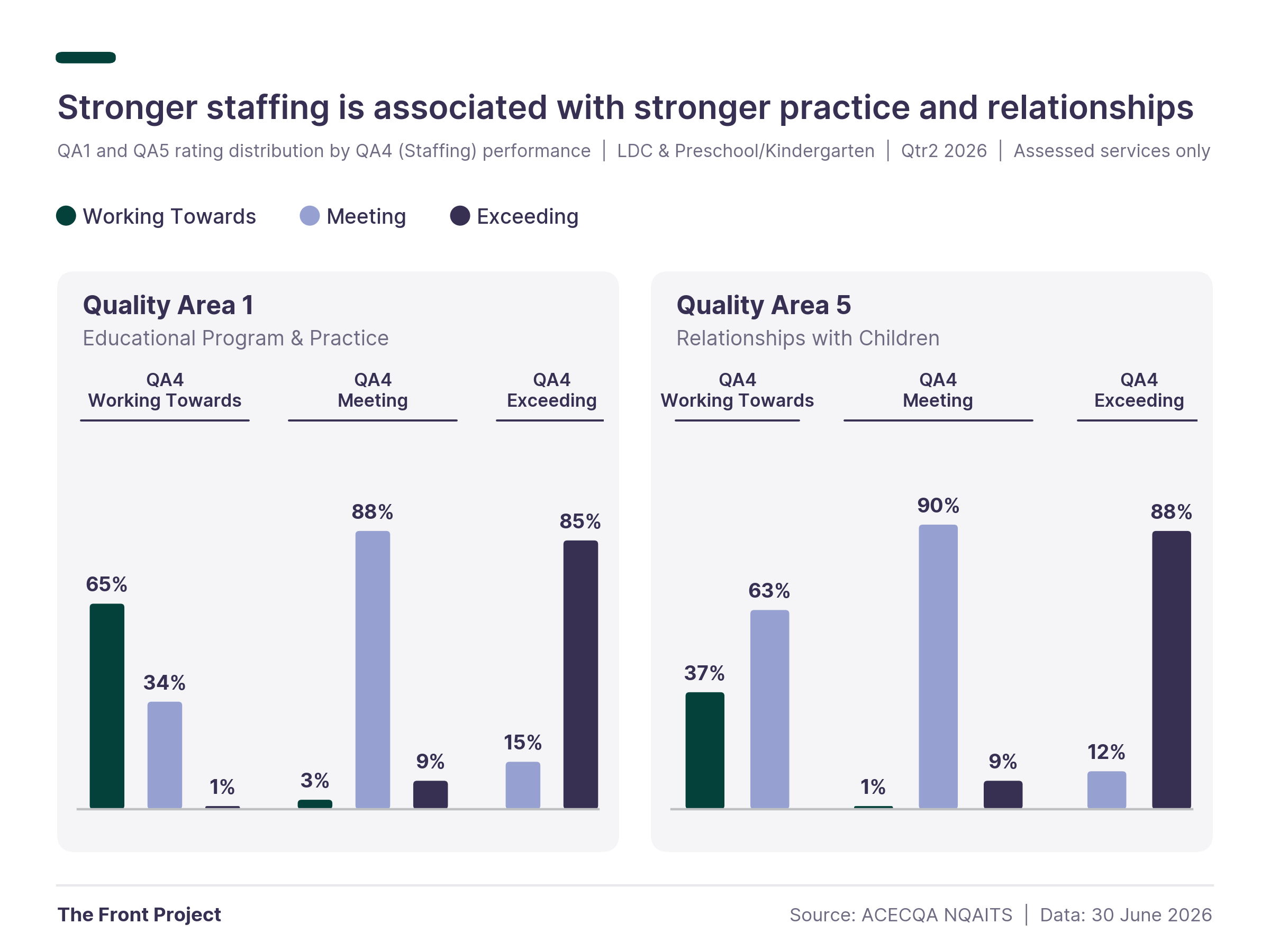
Services meeting or exceeding QA4 largely achieve the same rating in QA1 and QA5. Where services are working towards QA4, performance in QA1 and QA5 is more mixed.
Exceeding practice rarely happens without strong staffing. Only 1% of services working towards QA4 exceed QA1, and none exceed QA5. No service exceeding QA4 is working towards either QA1 or QA5.
Relationships appear to hold up better than educational programs when staffing falls short. Among services working towards QA4, 65% are also working towards QA1, but only 37% are working towards QA5.
This suggests educators might be prioritising their relationships with children under staffing pressure, while programming absorbs the strain.
Where do lower-performing services struggle most?
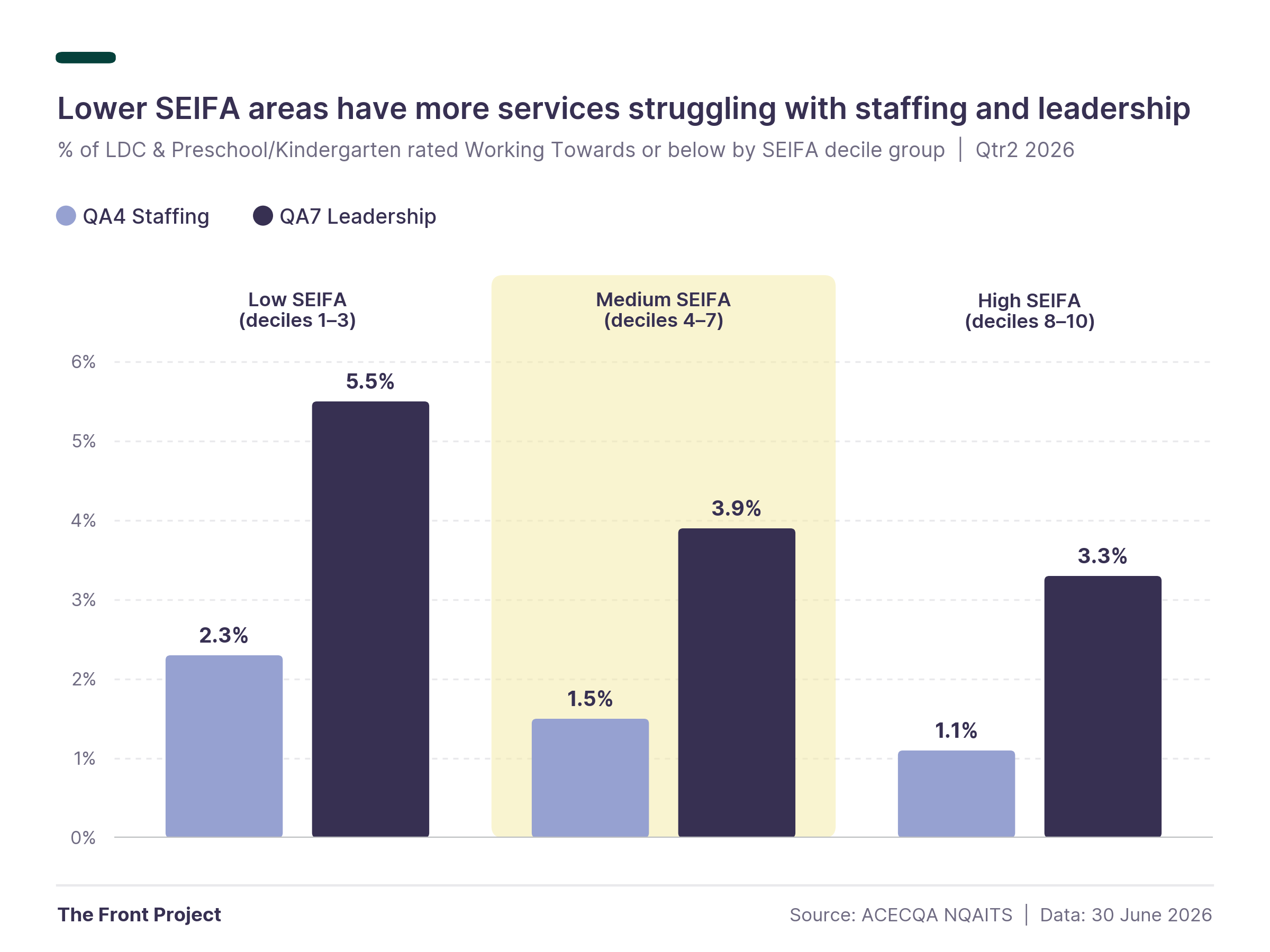
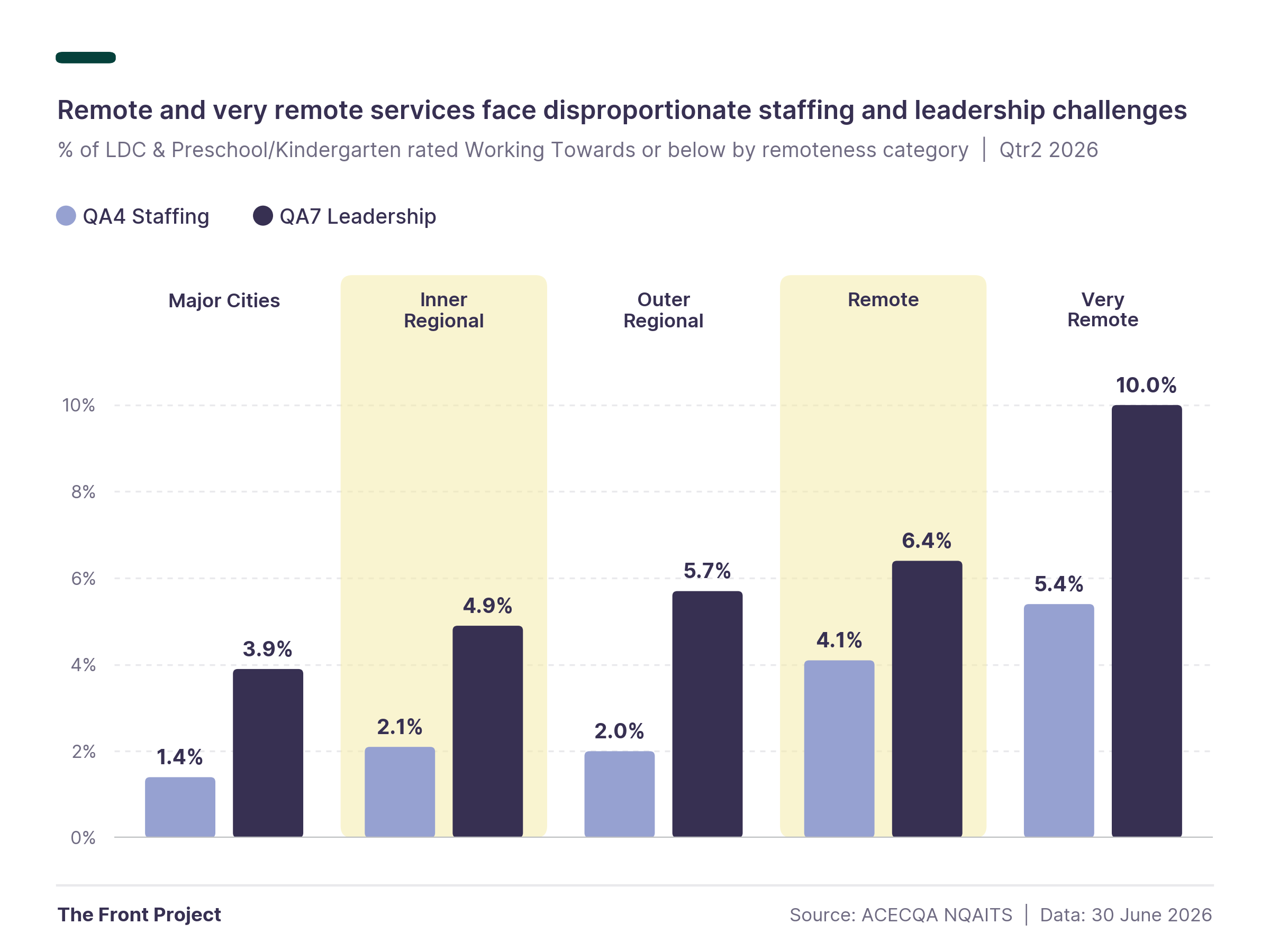
The further a service is from a major city, the more likely it is to be rated Working Towards in staffing and leadership, and the gap is widest for leadership. 10% of all very remote services are rated working toward in their leadership.
Socio-economic disadvantage shows a similar pattern. In low SEIFA areas, 5.5% of services are rated Working Towards or below in QA7 (Governance and leadership), compared with 3.3% in high SEIFA areas.
Across every SEIFA group, more services struggle with leadership than with staffing. This suggests that recruiting staff is only part of the challenge. Services also need to retain experienced educators, develop them into leaders and support them to work at their best.
Trends over time
Since 2020, the share of services exceeding in QA4 has fallen by about a third, from 33.1% to 21.4%, with most of that movement shifting to Meeting (up from 62.1% to 76.8%). Exceeding ratings in QA7 have tracked QA4 almost exactly, falling from 32.1% to 20.1%.
There is a strong trend between QA4 – staffing and QA7 – leadership trends over time, where both are declining their number of exceeding ratings in parallel. The decline is steady rather than sudden, pointing to sustained pressure on staffing and leadership across the system.
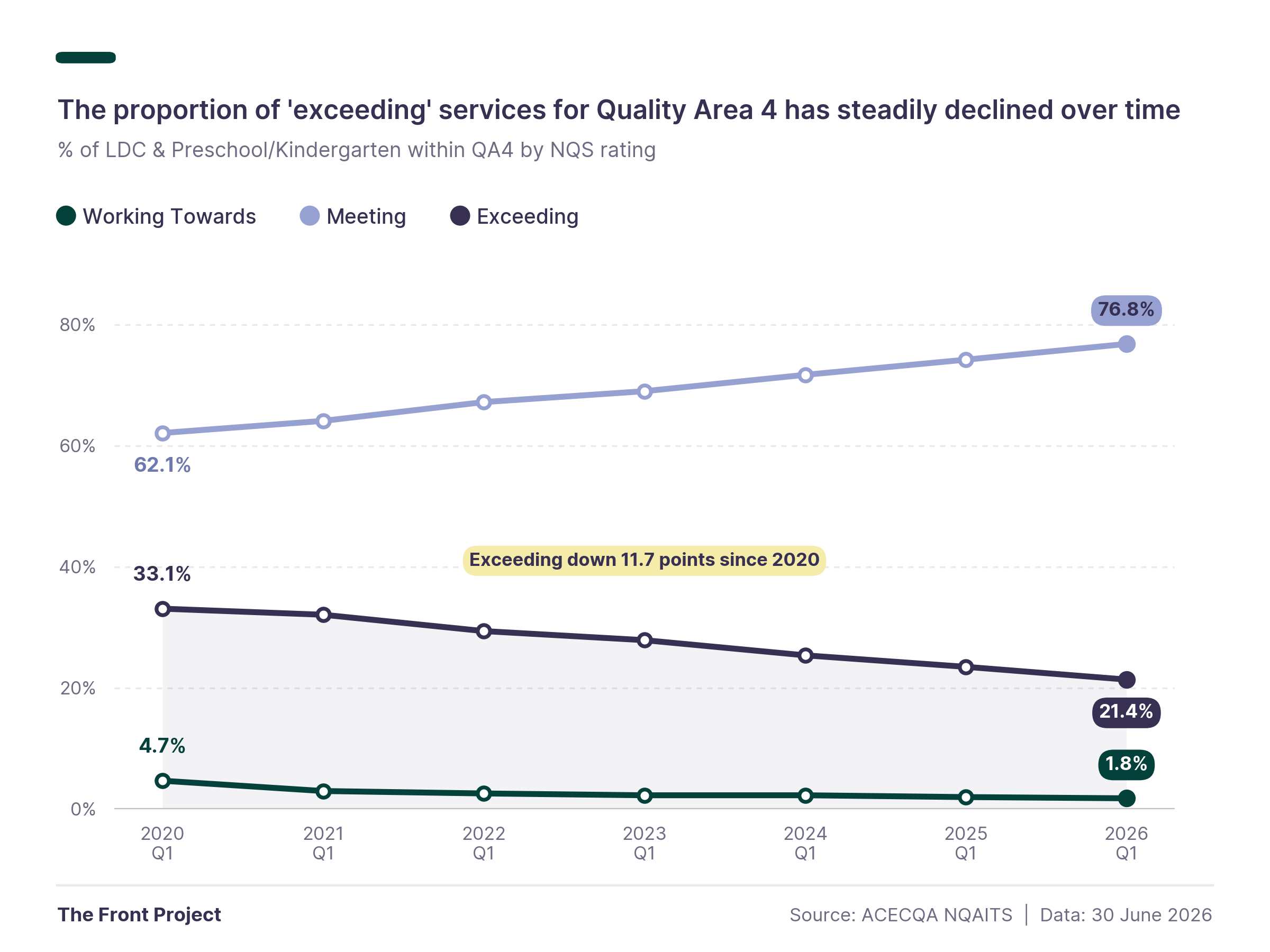
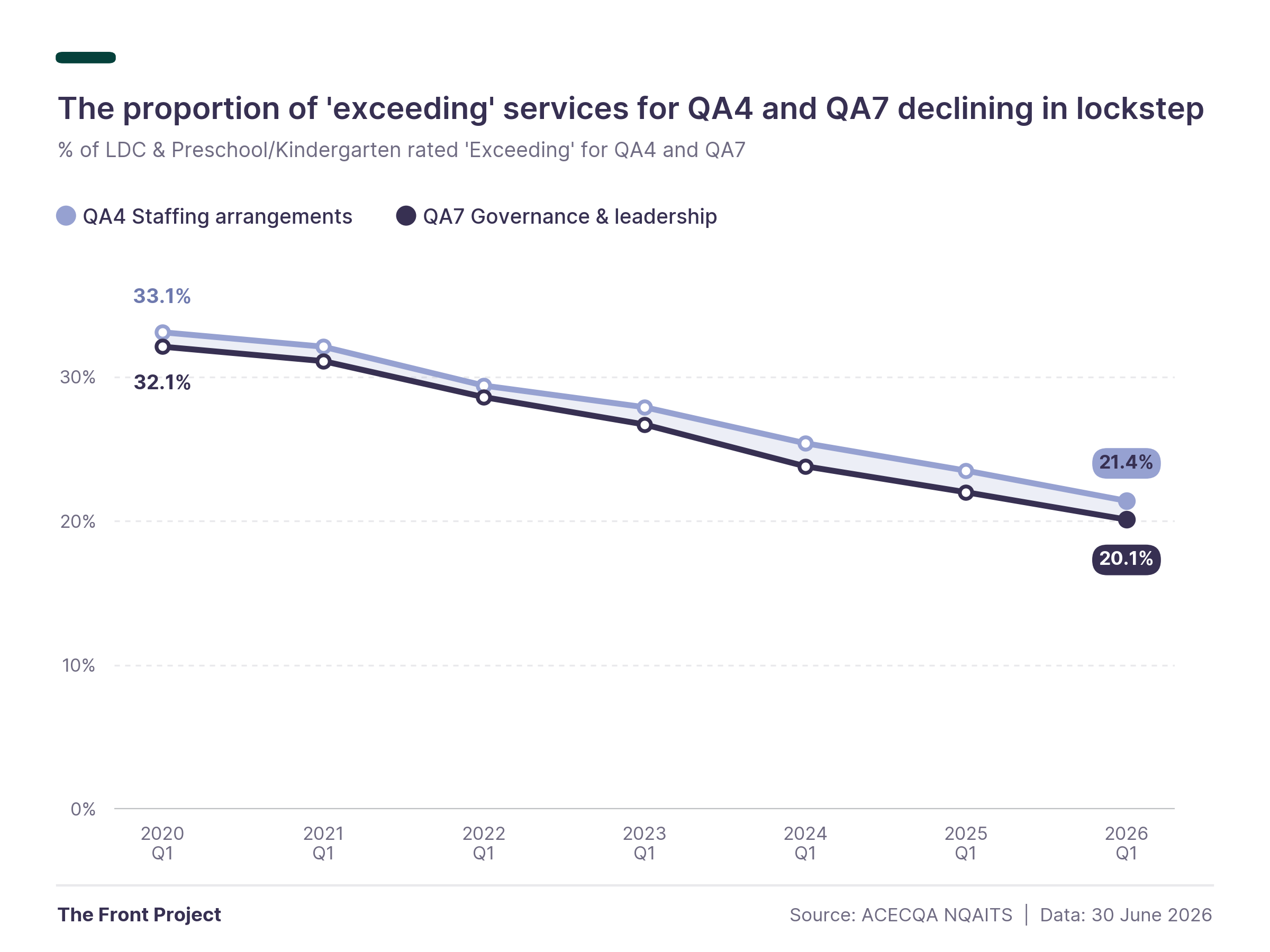
Quality staff matter at every level of a service, from educators in rooms to leaders in management roles. QA4 and QA7 move together because each depends on the other: well-supported educators have the opportunity to grow into strong leaders, and strong leaders create the conditions that support and develop their staff.
Staffing has been a focus of recent government policy, most notably through the Worker Retention Payment. Job vacancies have dropped, but this support for the workforce has not yet translated into exceeding ratings, which have declined steadily since 2020. Part of the lag is likely structural: services are typically reassessed only every few years, so improvements on the ground will take time to show in the ratings.
It also remains incumbent on governments and policymakers to design policy that goes beyond wages. Pay is the foundation, but lifting quality also depends on the conditions educators work in every day, including manageable workloads, time for programming and reflection, and pathways that develop educators into leaders.
Leaders themselves need dedicated time and management support to mentor their teams, rather than being stretched across operational and compliance demands. Sustained investment in these conditions is what will turn a more stable workforce into higher quality practice for children.