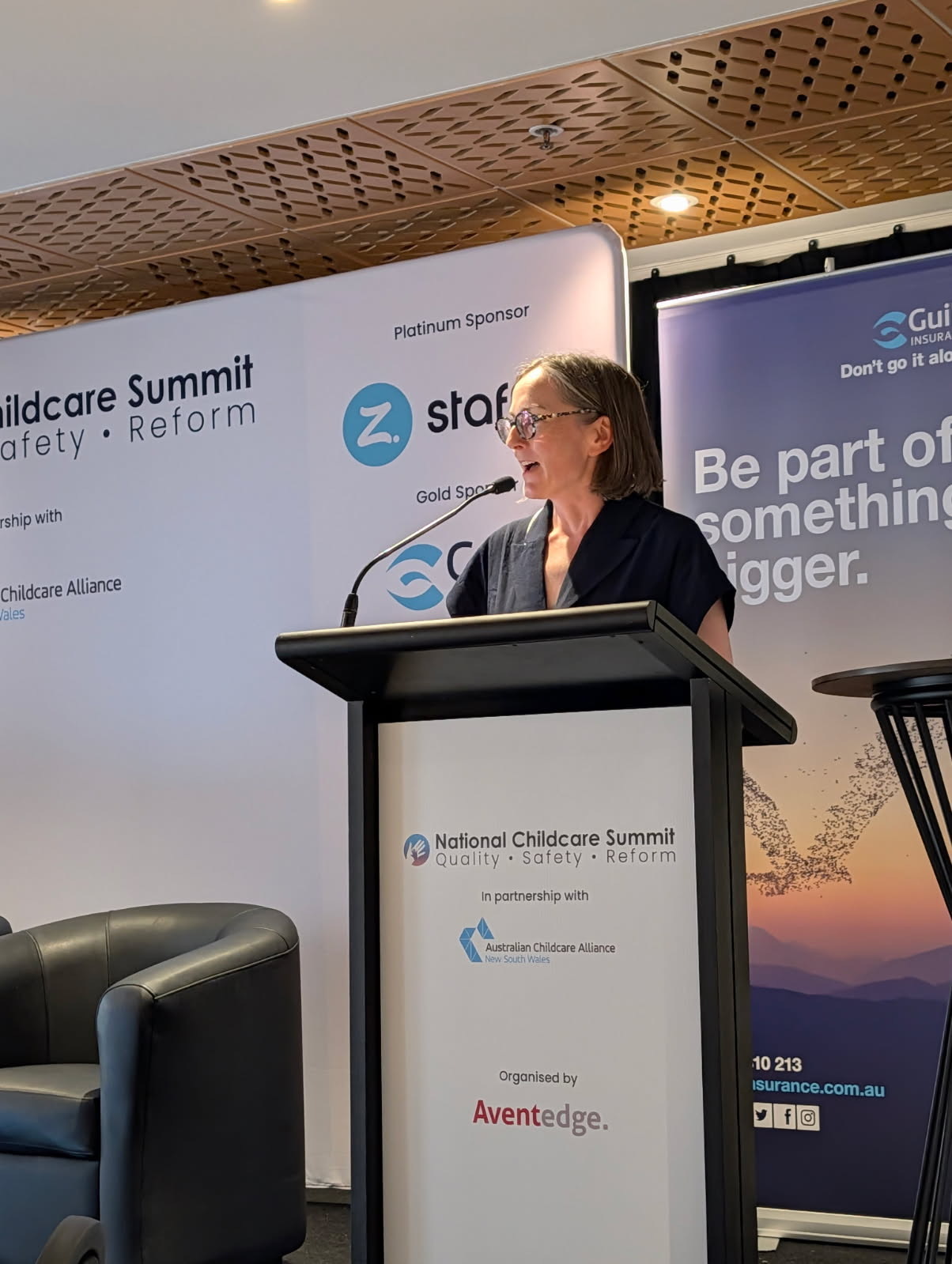
National Childcare Summit Speech
Speech by the Front Project CEO, Dr Caroline Croser-Barlow
03 December 2025
I would like to Acknowledge we are meeting on land of Gadigal people of the Eora nation and pay my respects to elders past and present.
One of my commitments to reconciliation is to amplify First Nations voices. So today I wanted to recommend the anthology which I’m sure lots of you have already encountered called Growing Up Aboriginal in Australia, 50 people sharing their really diverse stories. I loved it.
I’m here today to talk about building a system for every child that ensures quality.
I’m more optimistic than I was 13 months ago. It’s probably an understatement to say this last year has been a wild ride in ECEC.
That idea of a shifting Overton window – of the ways in which things that were unimaginable are now thinkable – has never held more resonance than in ECEC over the last year. 13 months ago, almost to the day, my team and I were in Parliament House in Canberra spruiking two reports.
The first was called NQF Works!
It profiles an AERO commissioned big data analysis showing that kids who attend higher quality rated centres in the two years before school have better development outcomes, as measured by the AEDC, than those who don’t.
Using econometric wizardry that takes into account all the variables that we know might otherwise change child development outcomes (like parental income, education, parental mental health and chronic health conditions, rural and regional status), this study showed that kids in Meeting services do better than those in Working Towards, kids in Exceeding do better than those in Meeting.
The second report was called ‘Addressing Market Imbalances to Achieve Quality and Affordable Childcare’.
This was much less econometric wizardry, and much more a simple look at stock and flow in centre-based day care. It showed that the stock of centre-based education and care has grown 69% since 2013, which is great. But the flow of entry and exits has been imbalanced – more for-profits, actively pushing out not for-profits in gentrifying areas.
More services have entered in higher SES areas, with stagnation – and even decline – in low SES and regional areas. Continuing disparities in overall quality between different provider types – a fact to which I will return later.
Those meetings crystallised a couple of things for me.
Firstly, Canberra politicians and policy makers didn’t know the strengths – or the weaknesses – of the ECEC system they funded.
We called it NQF Works! with an exclamation point because it was a surprise. And here I will make one of what will be many personal confessions about my own inadequacies on this journey.
One of the people it surprised was me.
In a way it’s not surprising that it’s surprising – it’s so rare that we – government, society design something that works at scale. So far, the National School Funding Reform Agreement hasn’t. Hospital reforms haven’t.
And yet, the NQF has.
And I have to say, for the new generation of politicians and policy makers who weren’t part of those moves, it was a surprise. They heard so often about the overwhelm of documentation, and inconsistent enforcement by regulators, it was shocking to hear that, actually, all of that was doing something.
Secondly, and I think on a related point, politicians and policy makers in Canberra had lost track of what it would mean to be responsible for more than making childcare cheap.
Remember, in October last year, the government had only just dipped their toe into the idea of investing in workforce pay directly through the Worker Retention Payment (announced August that year) – and that had been tied to a commitment to maintaining price control.
They had yet to announce the three day a week guarantee, or the Building Early Education Fund. Instead, the whole conversation was – will government commit to $10/day or not? How anachronistic that conversation seems now.
Fast forward to today.
On the weekend, the Australian Government announced a decision that Child Care Subsidy could be claimed by services for hours when they are closed, but educators are engaging in safety professional development.
It’s a modest commitment – closing an hour or two early a few days a year, but this innovation breaks the idea that CCS is just a voucher to make ECEC more affordable for families.
The Commonwealth is saying – we are responsible for more than cheap.
We share responsibility for workforce conditions that go to the safety and quality our children experience in ECEC.
This would have been almost unimaginable in November last year, and it was literally verboten when ACECQA was consulting on the National Workforce Strategy in the dying days of COVID through 2021.
We really are in a new world. An Australian Government funding wages AND conditions. Wild.
The Prime Minister’s ambition for universal is on track. A three day guarantee that removes the activity test, a significant investment in capital for expansion into childcare deserts – and presumably – though not for sure – in future, through opex investments under what the Service Delivery Price project suggests to ensure economic viability in every part of the country.
The next part is ensuring we build a system that is high quality and works for every child.
Why quality matters
I’m going to start with why quality matters. First, let me start with what I know is sometimes a point of dispute – should we talk about aiming for quality, or for high quality.
Why should we set the bar higher than just meeting the standard? Why should we aim for high quality?
Part of the answer is in that AERO study I referenced before – higher quality makes a bigger difference to child outcomes. And from separate research done over the space of decades, we know that that is especially true for children experiencing disadvantage.
As part of the SA Royal Commission into ECEC, we commissioned Deloitte to look at the benefit-cost ratio of universal 3-year-old preschool.
Turns out, to get a positive return, not only did we need the workforce participation benefits of universal participation at 3, but we also needed bigger child development returns from a quality boost to existing Long Daycare services.
This is intriguing. For a long time, the return on investment in ECEC has been framed around workforce participation, with a side hustle of child development. And as a card-carrying feminist, clearly the workforce participation priority is important.
But I think the ground is shifting under our feet a little on this.
I am no social commentator, but I can’t be alone in feeling that, as a society, we are in a crisis in relation to raising healthy, thriving kids.
A couple of data points to show this.
Firstly, last week, UNICEF launched a report on the State of Australia’s Children.
It noted declines in mental health, positive peer relationships, increases in anxiety about the future in school aged kids. It highlighted again the challenging results from the Australian Early Development Census in 2024, which essentially wiped out nearly two decades of developmental gains across much of Australia.
Secondly, a more personal one. And this really was my entry point to working on child development as an advocate. And I think given the significant interest in Inclusion Support Programs, I imagine it will resonate.
My last job before working on the SA ECEC Royal Commission included running disability in schools.
Because I was new in, I could see what my colleagues – like frogs boiling in a slowly heating pot – could not.
Something was changing in the ‘average’ classroom.
And we could see that teachers everywhere – from leafy suburbs to hard knock areas – were struggling. Burning out. Feeling unsupported and not able to cope with the complexity of the behaviours – because it’s usually behaviour – they were seeing.
And I could hear it among my friends and acquaintances. School refusal, anxiety. And it wasn’t just anecdotal.
The data showed that 1 in 4 children in an SA public school were identified as having a functional need – a disability - that required additional supports. 1 in 4. These day’s it’s 1 in 3.
These children were being sent home from school – suspended, more and more often, at a younger and younger age.
What’s more, when you started to unpick that data, you could see that by Year 4, almost 1 in 2 children had received some kind of adjustment for what the teacher identified as disability.
1 in 4 in any given classroom of that cohort, but nearly 1 in 2 of those kids were identified at some point between Reception and Year 4.
This isn’t an issue over there anymore – this isn’t an issue about disadvantaged kids, or kids 'over there'. This is an issue about ALL kids. Nearly 1 in 2.
The other thing I find interesting about this data is that the number bounces around. Kids identified one year, are not identified the next. And the variation is not in developmentally predictable patterns.
The clever people at Uni of Adelaide are looking at more linked data to understand what is going on. But, I suspect, it bounces around in relation to what’s going on for that child. At home. In their peer group.
And – especially - in relation to their teacher.
Which gets to one of the hardest things to wrap our heads around about children – they come in relation to others.
Professor Andrew Whitehouse said on radio the other day that the soil in which kids grow is time, attention, space and energy.
And I think Catherine Liddle would say – for Aboriginal and Torres Strait Islander kids - in culture.
Professor Whitehouse went on to say that, in 2025, parents and all those who are nuts about their kids, have never had less of any of time, attention, space and energy.
I have not been able to get it out of my head.
Because it holds for parents, and it holds for educators as well.
ECEC has become part of the soil in which we grow our children.
And we have to work out how to enrich it, because more and more, our kids aren’t thriving.
I often tell the story of the wonderful community childcare my kids attended.
Our life at that point was chaotic. We had a two-year-old, a baby, and we’d just assumed care of an eight-year-old. I had a new busy job, and a thirst to prove myself. My husband was working weekends and so we rarely saw each other properly.
Anyway, to say, awful.
But no worse or different than a million other families juggling family, work, complex family stuff.
I was a few weeks back from family leave, and the morning drop offs were getting worse and worse. I was getting tenser and tenser.
Peeling the two-year-old off my leg, whisper shouting at her ‘stop being so slow and just move’ as we got out of the car. Holding the squirming six-month-old baby with his arching back and pushing him at his educators.
And finally, one morning, the baby room leader, Micki, came up to me and said ‘this way isn’t working. Let’s find a better way’.
And I burst into tears.
And we did. I actually can’t really remember the things we did. I think we changed the room order we did the drop off. I think maybe they came and met me in the car park for the first few days.
Mostly, though, what changed was me.
I stopped viewing drop off as a thing to be done as quickly as possible so I could get on with my real job. As something I should expect to be as easy as using self-checkout at the supermarket.
I started viewing it as something else. More on that ‘something else’ in a second.
Let me contrast this with data Professor Karen Thorpe recently shared with me about a study of toddlers in Queensland services.
In the almost 13 months (on average) children in their sample had spent in ECEC, the number of primary educators the children had ranged between 2 and 25.
Put differently, they had an average of eight different educators caring for them. Or a new educator roughly every six weeks since ECEC entry.
When I think of handing over my arching back baby to a different primary carer every six weeks, I feel sick.
I think of Darren’s point today “We can’t build community when the faces keep changing”.
As a sector, I think there is a something in this contrast for us to grapple with.
We can focus on the fact that modern life is hard, stressful, fraught. That parents are frantic and demanding, and staff come and go.
Or we can think about the ways in which ECEC can be a place where children get the time, attention, space and energy in which they grow.
Where it’s not a transaction – you take my child, I give you my money.
It’s a relationship – we care for these children together.
This is of course something the ACCO sector has known and been showing us for decade. It’s time to start listening.
I know some of you will be thinking – ‘We can’t ask educators to be everything. We can’t ask them to be family counsellors as well as educators. It’s not their job to manage your chaos.’
But that’s not what I’m saying. Micki spoke to me not as a counsellor, but more as friend might. With the somewhat inexpert role of a friend saying ‘huh, you look frazzled. Are you ok?’ But also, as a co-worker – this is bad for all of us! Our joint product isn’t doing well.
Micki spoke to me because we were in a partnership together.
Which brings us to the second thing we have to realise if we want to build a high-quality system that works for every child.
Quality isn’t an accident.
It takes work. It takes continuous tending.
We all know it – instinctively – that human work is not static, not stable.
We’ve all worked in teams where a good person left, or something has happened, and all the things that worked before – from the ability to get high quality work out the door to deadlines, to the peaceful resolution of questions like ‘whose yoghurt is sitting in the fridge’ - no longer work as well.
Now take children – whose brains are wired for connection, and which can’t grow in the absence of secure attachment – and multiply the impacts of this volatility of human connection a million fold.
Because they will be impacted not just by the skills of their educator, but by how frazzled they are, how well they got on with their colleagues, whether someone comes on the floor and offers them ideas about how they’re working, whether they can get time to think and reflect.
Building and maintaining a quality service that delivers that secure attachment, that supports that high quality relational back and forth, takes intentional effort, investment and expertise to keep that humming.
Effort by the people running the service, by the providers employing them, by the policy makers running the system.
System choices shape the ability to be quality
So I wanted to spend the rest of my time talking about the soil in which quality grows.
This soil, I would argue, is primarily made by policy makers and providers. Not by educators. Not even by centre leaders – though I think they are the gardeners. Some of this will be obvious to you.
Policy, for example, shapes what level of qualification your workforce must have; what are the legislated ratios of adults to children.
Indirectly, it shapes how much funding is available through the hourly rate cap and who is eligible for what level of subsidy.
Providers choose who runs services and what you are looking for when they choose them, how many rooms you think is the right number of rooms to operate, what kind of investments you make in professional development and more.
But then, if we really want quality as a system, we – policy makers, providers - have to take the time, pay attention, focus our energy, make space to see what grows.
We need a learning system.
Policy makers, or providers, who approach their decisions with the idea that child care is an ‘industry’, where widgets come together in predictable ways – this many inputs, this many outputs, are going to constantly be surprised by what happens.
This is because, well, humans are, well, humans.
My favourite example of this is around safety in outdoor spaces.
The estimable Sandra Cheeseman talked to me about why we were seeing so many children escaping from their outdoor spaces. And she talked about how children are naturally curious, and explorers. And bored in their very safe outdoor spaces.
Reducing risks increases the chances that kids escape!
Now this is tricky.
Because I think policy makers and providers who haven’t grown up as educators – like me, find this hard to get our heads around.
I’m a public servant at heart.
I think - why can’t it just be a checklist? Why can’t it just be widgets?
Again. Because. Humans.
So we need to commit to consciously tending the sector for quality.
This is what wonks mean when we talk about stewardship.
It’s not just putting in place rules, or giving more money.
It’s about active thinking about what’s going on, taking course corrective decisions along the way, to ensure we stay on the right track.
There are a number of ways of doing this work of stewardship.
The Productivity Commission recommended a national commission, and I, for various reasons I am happy to explain in the Q&A if we get to it, am inclined to think this is a good way forward.
Of course, it could also be that the Commonwealth and the States get clearer and more accountable about their responsibilities.
But I think whatever the mechanism, we are living the consequences of not having that steward. Let’s go back 11 months ago - before the election, after 4 Corners but before Joshua Brown, we could see the Commonwealth pointing to the states for not regulating strongly enough. And the states pointing to the Commonwealth for putting so much money on the table without investing in a quality architecture.
But I think what we have learned collectively over the last year is that we need answers that aren’t just ‘more rules’ or ‘more money’.
We need to find a bigger toolkit.
The workforce panel, and the fabulous Anna Learmonth, reminded me that one tool is actually just making choices.
We talk about ratios as though the only way of meeting increased ratios is increased supply of workforce. That’s not quite true. There are other policy levers you can pull – either in the short term or the long term.
Expanding Paid Parental Leave to 12 months would reduce demand for baby rooms.
Another constraint would be targeting areas of oversupply, and constraining entry into oversupplied areas.
Lyn was making the point that dramatically improving our support for the inclusion support program could be game changing for retention.
One tool I’m particularly interested is in our administrative data.
I think we can use it to spot patterns. Do we see more serious incidents in services where our staff are less experienced? Where we use a greater proportion of casuals? Is there a tipping point?
Now, this insight wouldn’t make for a good rule. Have no more than 1 in 3 staff who have only been in the sector a year would be a terrible rule.
Context is king. It would be gamed.
But it is very useful information that a system steward should be using.
It is useful information for providers who can build it into their approach.
We’ve done a similar piece of work at the Front Project, looking at the employment conditions – time off the floor, additional leave entitlements – of Exceeding services in low SES areas, compared to those services that are Meeting and Working Towards. It’s called The Hidden Lever, encourage you to take a peek.
But I need to say out loud, this idea that we can use nuanced data analysis only works if you assume everyone in the sector is motivated to work toward quality.
This is where what motivates you to be in the business matters.
There’s a lot of focus about the role of for-profits and not-for-profits in our system.
And I am part of that.
It’s not ideological for me. It’s fact!
We can’t ignore the over representation of for-profits in all the bad bits… but it is equally true that there are some extraordinarily high quality for profit services.
And, as Paul Mondo will tell you – the only sustainable business model is quality – where workforce turnover is reduced, where good relationships are maintained with children and family.
I think we need to find more nuanced ways of having this conversation.
For example, while we can recognise the important role for-profits have played in bringing capital to bring on supply for families who desperately wanted and needed care, I think we should be deeply dispirited by the idea of fast capital in our sector.
Fast incentives, a ‘fix and flip’ business model, doesn’t lead to a focus on quality or learning what works for children.
So the question then becomes, how do we make sure providers are motivated to provide quality?
I don’t have a single answer – I think this is something we will need to work our way into.
Fundamentally, we need a system that encourages providers to lift or leave.
More rigorous enforcement and chopping off funding should do a lot to cut out bad faith actors.
Designing funding streams or a funding model that incentivise a commitment to quality is another.
This is the conversation we need to have together. What will work.
My engagement manager tells me it is helpful to always think about what you want your audience to think, feel and do when you leave them.
Of course you’re not supposed to say it out loud, but here’s best go at it.
I want you to think the long wave of reform work that is coming – not as ‘yet another thing’, but as the opportunity to build better.
It is going to require doing new things.
It is going to require government to learn their way into new things. It’s going to require patience as inevitably get bits wonky on their way. I want you to operate from a place of good faith.
I want you to feel the power of the idea that children grow in time, attention, space and energy, and feel the challenge of what that means for your choices.
In terms of do? I have heard lots of things today that are so encouraging, and yet, sometimes – and again, as a bureaucrat, sometimes there is a gap between what we are trying to do and how educators are experiencing their world. Spend some time, walk the floor.
Despite the wild ride of the last 14 months, I am incredibly optimistic about the future of ECEC.
Because for the first time, I am seeing a galvanised force – of governments, of policy makers, of sector leaders, of families – who are demanding more from the ad hoc series of investments that have been made.
We are seeing a commitment to the idea that we are, in fact, building a system. A high quality system that works for everyone.
Thank you.